
Doctors Don’t Need Another AI Dashboard
They need technology that fits into the way they already think and work.
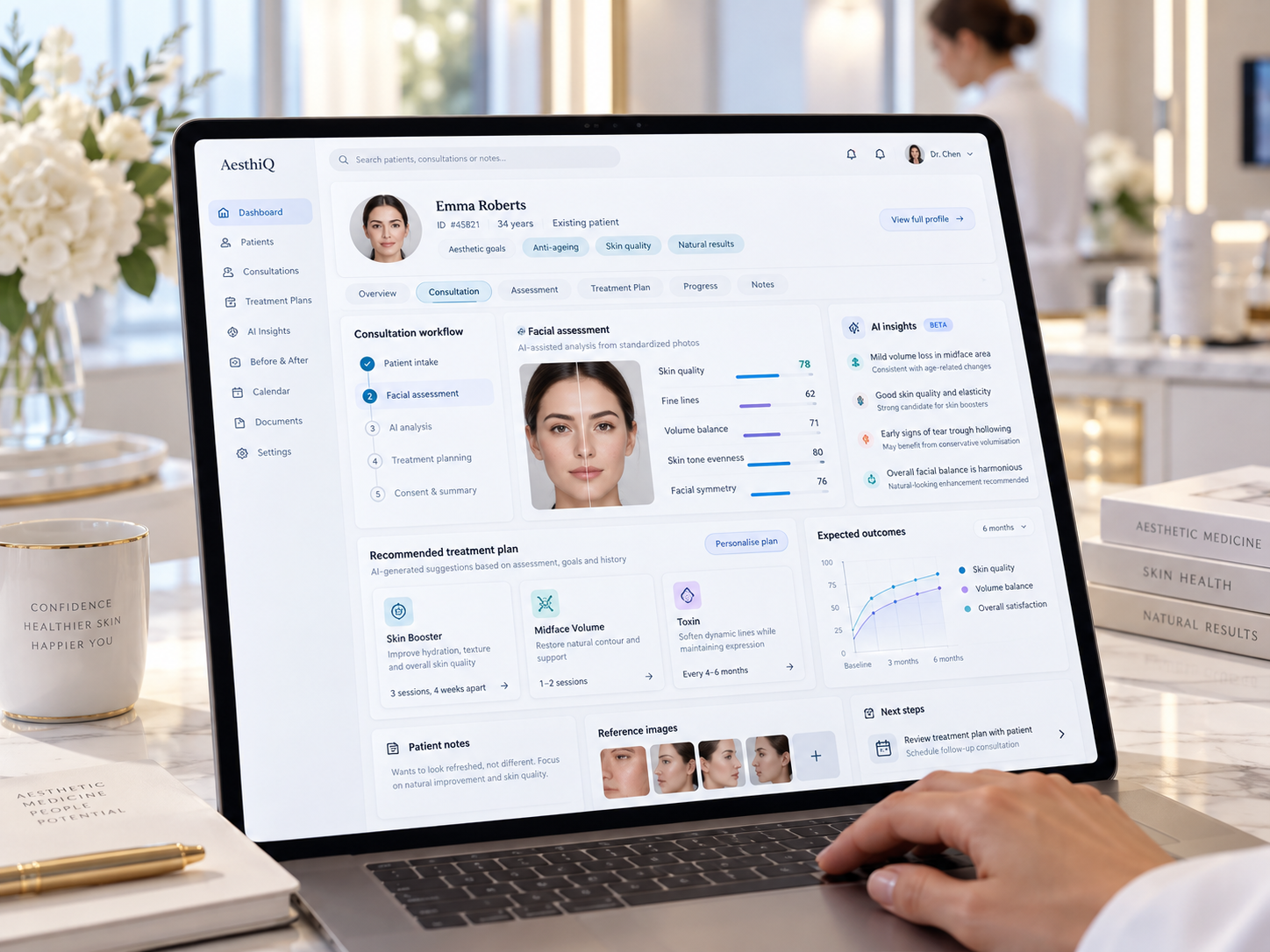
On September 23, Medical Economics published a piece that raises a deceptively simple question for any medical practice considering AI:
Does the tool actually remove work — or does it simply move the work somewhere else?
That distinction matters.
Because adding AI to a medical practice is easy.
Another platform. Another login. Another screen. Another dashboard. Another workflow for the team to remember.
But if the technology requires the physician to manage an additional layer of work, it may be new without actually being better.
The article argues that AI should be evaluated by whether it removes bottlenecks, fits existing workflows and creates measurable operational value — not by how advanced it sounds.
For aesthetic medicine, that principle becomes especially relevant.
The problem isn’t a lack of screens
An aesthetic consultation already contains a lot of information.
The patient arrives with a concern.
The physician listens.
Looks at the face.
Reviews medical history.
Captures photographs.
Assesses different areas.
Considers treatment possibilities.
Explains.
Documents.
And ultimately turns all of that into a strategy the patient can understand and act on.
If we insert an AI system into that process that requires the physician to stop, enter information, move to another screen, select options, copy outputs and then return to the patient, we have not necessarily solved the problem.
We may simply have added another step.
AI should not become another task inside the consultation
There is a relatively easy way to build an AI product:
Create a dashboard.
Ask the physician to enter information.
Generate an output.
Leave the physician to decide what to do with it.
Technically, that can be impressive.
From a workflow perspective, it is a different question entirely.
Because during a consultation, physicians do not think in dashboards.
They think about the patient.
What is bothering them?
What do I see?
What matters clinically?
What are the options?
What should I recommend?
That thinking process already exists.
The best technology should know how to fit inside it.
In aesthetics, the workflow already exists
An aesthetic consultation can be described very simply:
The patient arrives with a concern.
The physician assesses the face.
Treatment possibilities emerge.
A strategy is built.
Those are not product features.
That is the workflow.
So the right question for AI is not:
What additional screen can we insert here?
It is:
How can technology connect the steps that already exist?
That small change in framing has major implications for product design.
Why another dashboard can make the problem worse
Every new dashboard asks something from the user.
Attention.
Time.
Training.
Context switching.
Sometimes even duplicate data entry.
And those costs are not always obvious at first.
A system may save two minutes on one task but add three minutes of setup, review and navigation.
It may generate a recommendation quickly but require the physician to manually move that information somewhere else.
It may automate one process while still requiring staff to log into another system just to understand what happened.
That is one of the central warnings in the Medical Economics piece: when AI simply shifts work into another dashboard, login or parallel workflow, it can increase friction instead of removing it.
“Does it use AI?” is the wrong question
It may actually be the least interesting question.
AI is not an outcome.
It is a means.
Practices should not adopt technology simply because the product has AI in its name.
The more useful questions are:
Does it shorten a process?
Does it remove a step?
Does it connect information that already exists?
Does it reduce movement between systems?
Does it allow the physician to stay inside the natural flow of the consultation?
Does it give the team fewer things to manage and remember?
That is the difference between an AI feature and workflow technology.
What does this mean for aesthetic medicine?
In aesthetics, the value of AI does not have to begin with dramatic diagnosis or with technology attempting to make decisions for the physician.
Sometimes the most meaningful value is much more practical.
The patient speaks.
Information stays connected to the case.
Photography becomes part of the assessment.
The assessment becomes structured.
Treatment possibilities connect to what has been identified.
And a strategy begins to take shape.
In other words:
AI should help connect those steps — not add another one.
That also means technology does not need to become the star of the consultation.
Its role is to make the consultation itself clearer.
Where Epiderm AI fits
The more useful way to think about Epiderm AI is not as another dashboard the physician has to “use.”
It is a workflow:
Patient conversation → information → structured facial assessment → treatment strategy.
Patient information provides context.
Photography becomes part of the assessment.
The assessment becomes structured.
And that structure can support treatment planning.
The practitioner still reviews.
The practitioner still interprets.
The practitioner still decides.
The technology helps connect the steps.
That distinction matters.
Because clinical AI should not require physicians to work for the software.
The software should work within the way physicians already work.
Maybe this is the real measure of good AI
Not how many dashboards it has.
Not how many prompts it accepts.
Not how many outputs it can generate.
But how much friction it removes.
Does the workflow feel simpler after the technology is introduced?
Is there less copying?
Less switching between systems?
Less administration?
Fewer actions the physician has to remember?
If the answer is no, then we may have added AI without actually improving the workflow.
The direction healthcare is moving toward may ultimately look less impressive from the outside — and feel far more meaningful from within.
Less:
“Look at our AI.”
More:
“Can the physician simply keep working?”
And in aesthetic medicine, that may be exactly the point.
The patient arrives with a concern. The physician assesses the face. Treatment possibilities emerge. A strategy is built.
AI should not become step five.
It should help the first four steps connect.
Technology should fit the consultation — not interrupt it.
See how Epiderm AI connects patient information, photography, structured facial assessment and treatment planning within one workflow.