
Clinical AI Is Moving Deeper Into the Workflow
The future of medical AI may be much less visible than we think.
Not another AI tool.
Not another tab.
Not another login.
But AI appearing exactly where the clinical decision is being made.
This week, the University of Texas Medical Branch and OpenEvidence announced a collaboration that embeds OpenEvidence directly inside UTMB’s electronic health record environment.
Instead of requiring clinicians to leave the EHR, open another application and move information between systems, OpenEvidence is available inside the workflow they already use. Clinicians can also access it through their standard UTMB enterprise credentials rather than creating separate accounts.
The integration went live in March, and UTMB reports significant growth in adoption since then, with more than half of its clinicians now using the platform.
But the adoption number may not be the most interesting part.
The deeper insight is:
The most useful clinical AI is disappearing into the workflow.
For years, AI was somewhere clinicians had to go
Many early medical AI products followed a standalone model.
Have a question?
Open another platform.
Sign in.
Enter information.
Ask the AI.
Read the answer.
Then return to the EHR or clinical system where the actual work is happening.
The AI may be excellent.
But from a workflow perspective, another step has been added.
And in clinical environments, every additional transition asks something from the clinician:
time, attention, context switching, and sometimes duplicate data entry.
UTMB describes the new integration through exactly this lens: rather than requiring clinicians to move between disconnected applications or create additional accounts, OpenEvidence is brought directly into the existing clinical environment.
AI should appear where the decision happens
That is a meaningful shift.
A physician should not have to think:
“Now I need to use AI.”
They should be working through a normal clinical process, reach a moment where additional evidence or context is useful, and receive that support there.
It changes the product model.
Instead of:
clinical workflow → stop → AI tool → return to workflow
it becomes:
clinical workflow → AI appears where needed → decision continues
AI is no longer sitting beside the work.
It is becoming part of the work.
Adoption is not only about model quality
Medical AI conversations often focus on the model itself.
How intelligent is it?
How accurate is it?
How well can it search the literature?
Those questions matter.
But even a strong system can become something clinicians barely use if it requires them to leave their natural workflow every time they need it.
UTMB’s own framing is revealing: its leadership says adoption has grown as friction was removed and useful AI was placed where clinicians already work.
That may be one of the most important lessons for the next generation of medical AI.
Distribution through workflow may matter almost as much as intelligence.
The future of medical AI may actually look less like AI
The popular image of AI is highly visible.
A smart dashboard.
A chatbot.
A screen full of insights.
Indicators designed to show that the system is “thinking.”
But as clinical AI matures, the experience may become much quieter.
The AI may live:
inside the EHR,
inside documentation,
inside information retrieval,
inside planning,
inside the exact point where a clinician needs support.
That matters.
Because the goal is not to make physicians constantly aware that they are using AI.
The goal is to help them work better.
The same principle applies to aesthetics — in a different workflow
Aesthetic medicine is not a hospital system.
But the workflow challenge is surprisingly similar.
The patient arrives.
A conversation begins.
The practitioner gathers information.
Assesses the face.
Captures photographs.
Identifies concerns.
Considers treatment possibilities.
And ultimately builds a strategy.
AI can be inserted into that process in a very visible way:
stop the consultation,
open an AI tool,
upload an image,
ask a question,
receive an answer,
return to the patient.
But then AI becomes another task around the consultation.
The more interesting model is different:
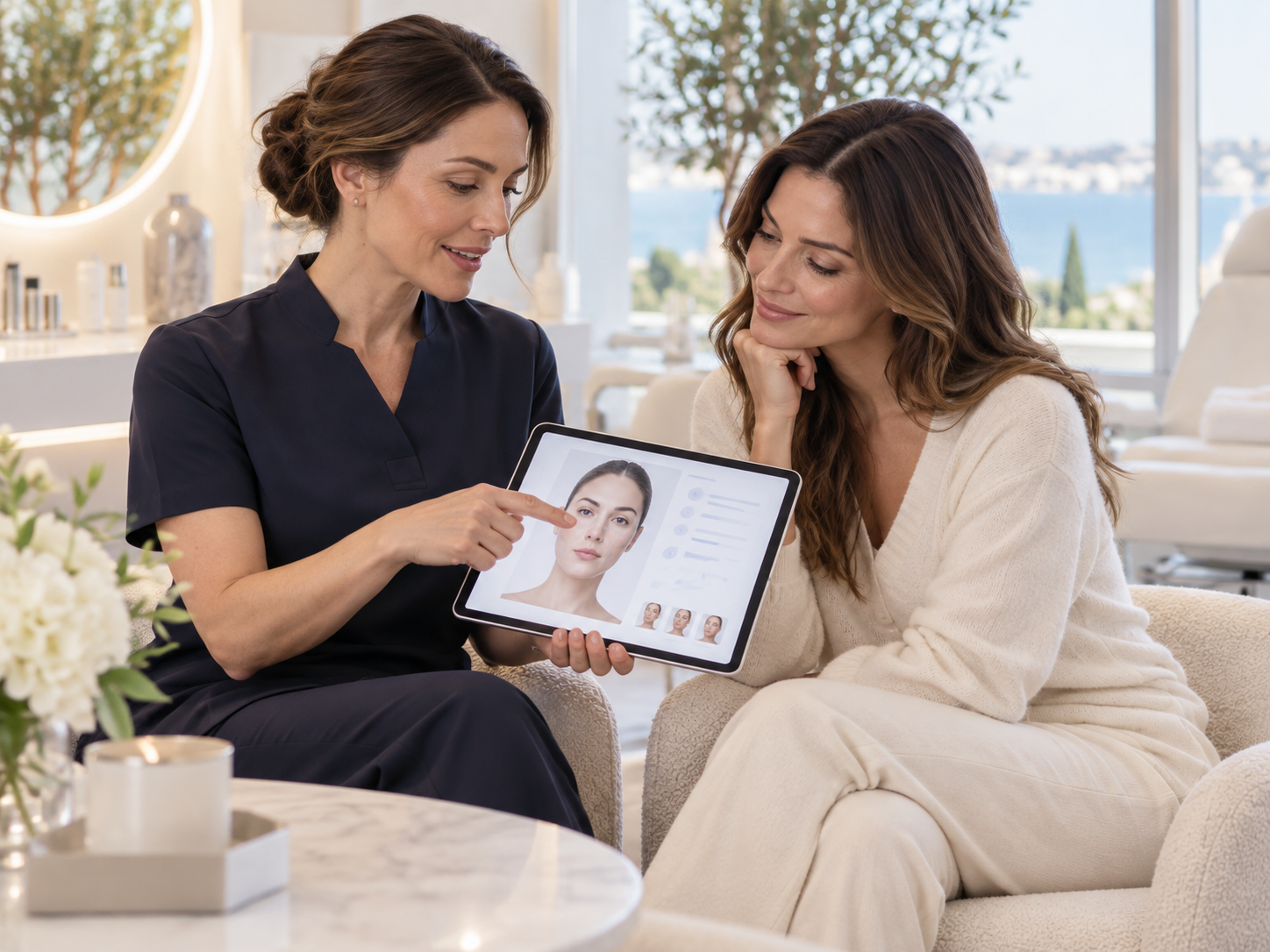
Patient arrives → Consultation → Structured facial assessment → Treatment possibilities → Physician strategy
AI becomes part of the transitions between those steps.
Not a separate destination.
But part of the consultation workflow.
“AI face scanner” may be too narrow a category
If AI in aesthetics is understood only as a tool that scans a face and generates an analysis, much of its potential is missed.
Because consultation is not only analysis.
It includes context.
History.
Photography.
Facial assessment.
Goals.
Patient conversation.
Treatment possibilities.
Planning.
Documentation.
The value is not only in what AI can “see.”
It is also in what it can help connect.
Where Epiderm AI fits
A more useful way to think about Epiderm AI is not:
“This is where the physician uses AI.”
It is:
Patient → information → consultation → structured facial assessment → treatment possibilities → strategy.
Information should not have to leave the patient context and enter an isolated AI tool just to generate an output.
Photography should remain connected to assessment.
Assessment should connect to treatment planning.
Planning should remain inside the clinical workflow.
The practitioner still assesses.
The practitioner still interprets.
The practitioner still decides.
But the technology is placed where the work is actually happening.
Good AI may stop feeling like AI
That may be the most interesting shift of all.
The most successful clinical products of the future may not be the ones where AI is most visible.
They may be the ones where it feels most natural.
Less:
“Click here to use AI.”
More:
“You are already at the point where AI can help.”
Less standalone tool.
More intelligence inside the process.
Less interruption.
More continuity.
The workflow is becoming the product
That may be what connects many of the developments happening across clinical AI right now.
Ambient AI is moving into documentation.
Evidence AI is moving into the EHR.
Decision-support tools are moving closer to the point of care.
The direction is not only better AI.
It is AI that understands where it belongs.
UTMB itself frames the OpenEvidence deployment as part of a broader strategy not to treat AI as a collection of standalone applications, but as capabilities that can be securely incorporated into existing clinical and operational workflows.
That is a meaningful sign of maturity.
The future may not be “physician + AI tool”
It may look much more like:
physician + workflow with AI inside it.
And in aesthetic medicine:
The patient arrives.
The consultation begins.
The face is assessed.
The possibilities become clearer.
The physician builds a strategy.
And AI is present at the moments where it can add value.
Not before the process.
Not outside the process.
And not as another task to manage.
AI becomes part of the consultation — not another task around it.
The best AI fits the way clinicians already work.
See how Epiderm AI connects patient information, photography, structured facial assessment and treatment planning within one consultation workflow.